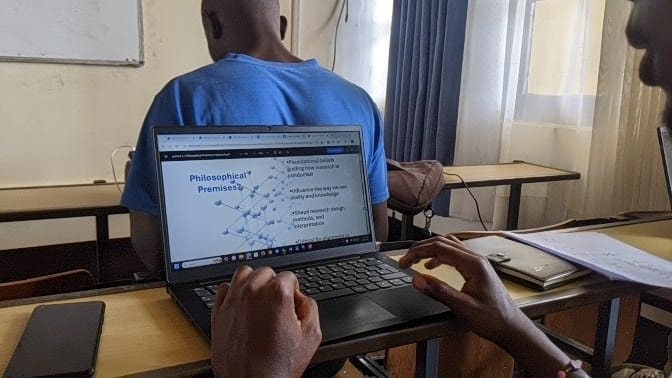
Students at the University of Rwanda (UR), Huye Campus, have welcomed a laptop loan programme implemented in partnership with the Development Bank of Rwanda (BRD), saying it has significantly improved their learning experience.
Under the programme, a total of 8,934 Lenovo laptops were distributed to students at the Huye Campus between 2023 and 2025. The devices, ranging from Lenovo i3, i5 and i7 models, are allocated based on students’ academic programmes and study needs.
Beneficiaries say access to personal laptops has transformed their academic routines, enabling them to store and review lecture materials with ease, conduct research more efficiently, and prepare assignments and examinations more effectively.
Nadia, a second-year Accounting and Finance student, said the laptops have eased many academic challenges. “Conducting research on their courses is now faster and more effective, Preparing assignments and projects is more convenient with personal access to technology,” she said.
Other students echoed similar sentiments, describing the initiative as a major boost to independent study and digital learning.
Josephate, a Clinical Psychology student, said the programme had addressed long-standing difficulties faced by students. “We thank UR for working with BRD. This initiative has solved many challenges we used to face,” he said, adding that preparing coursework and projects is more convenient with first hand access to technology.
Students also praised the University of Rwanda leadership for collaborating with BRD, noting that the programme aligns with the growing importance of technology in higher education and research.
However, university officials have urged beneficiaries to use the laptops responsibly. Kabagambe Ignatius, Head of Corporate Communications at the University of Rwanda, stressed that the devices are provided strictly for academic purposes under a loan scheme.
“These machines are given on loan to support learning. Any student who attempts to sell a laptop will face severe consequences, including permanent dismissal from the university,” Kabagambe warned.
He further advised students who already own computers not to apply for the loan unnecessarily, noting that the devices are intended for those who genuinely need them.
Kabagambe added that the continuation of the programme depends on available funding and annual evaluations by the government through the education budget. “I cannot say exactly how long it will last, but its future is tied to financial allocations,” he said.
The BRD-backed laptop loan programme is widely seen as a strong example of collaboration between government institutions and higher learning institutions to strengthen access to quality education.
Nafissa Umuziranenge / The Kaminuza Star