


Potato farmers across Rwanda are calling for improved seed varieties that can withstand diseases without the need for expensive pesticides. They say the cost of chemicals and the time required to apply them are cutting deeply into their profits.
In Nyabimata Sector, Nyaruguru District, Kayitana Matayo, who cultivates nearly one hectare of potatoes, says one of the biggest challenges is that the seed varieties they use are highly vulnerable to disease.
“We need fertilizers and pesticides for these potatoes, and all that requires money,” said Kayitana. “You end up spending so much that making a profit becomes difficult.”
This problem is common across the country. Farmers in Musanze and other potato-growing districts also report that pesticide prices are becoming unbearable and are urging agricultural researchers to provide them with disease-resistant seeds.
“Pesticides are expensive, and applying them several times is very difficult,” said Uwimana Venuste, another farmer. “If we had seeds that don’t need spraying and can resist diseases, it would increase productivity and save us time.”
The same concern is shared by Narcisse Karengera, head of a cooperative that grows potatoes on 101 hectares in Muganza Sector, Nyaruguru District. He notes that potato farming has become costly because of the constant need to fight a disease known locally as ‘Uruhoko’.
“Growing potatoes forces us to use pesticides because of diseases like Uruhoko,” he said. “Pesticides are very expensive and hard to find.”
He adds that the price of a chemical that once cost 12,000 Rwandan francs now sells for 32,000 francs, while another that used to cost 1,500 francs is now 15,000 francs. He and other farmers therefore hope to get improved seed varieties that do not require spraying.
Researchers Launch Disease-Resistant Potatoes
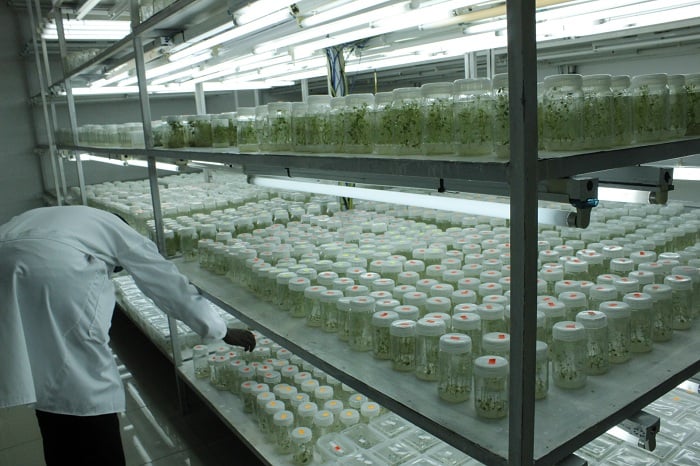
In Musanze District, Fidela Nikuze, a laboratory technician at the Rwanda Agriculture and Animal Resources Development Board (RAB), says researchers are already testing a new potato variety that has been genetically enhanced to resist diseases and adapt to climate change.
“These potatoes have been enhanced to tolerate climate variations and fight diseases,” Fidela explained. “We are still in the testing phase to see the kind of yields they can produce.”
According to Pacifique Nshimiyimana, Country Director of Alliance for Science Rwanda, the new variety will not only reduce the burden on farmers but will also help protect the environment.
“The pesticides we spray on potatoes don’t only kill the disease but also destroy small soil insects,” he said. “Once this enhanced variety starts being cultivated, it will solve that problem.”
Nshimiyimana adds that the new disease-resistant potato will also help address complaints from beekeepers in the Northern Province, who say that pesticides used in potato farming have been killing their bees.
A law published in the Official Gazette on February 21, 2024, now allows the use of biotechnology to strengthen crops so they can better resist diseases and adapt to climate change.
Dr. Athanase Nduwumuremyi, a researcher at RAB and coordinator of OFAB Rwanda (Open Forum on Agricultural Biotechnology), says the new potato variety will help reduce production costs and lower market prices.
“Currently, pesticides can increase the cost of potato production by up to 40%,” he said. “If we remove that cost while increasing yields, farmers will produce more at a lower price, and consumers will also benefit from cheaper potatoes.”
Dr. Nduwumuremyi adds that the new variety will only be released to farmers after thorough trials.
“There’s a process to follow,” he said. “We have already applied for authorization to conduct field tests with farmers. We will start with a few of them, and if they are satisfied, we will move to the next stage of seed multiplication so that more farmers can access it.”
Dr. Eric Magembe from Kenya, a senior researcher in the Global Biotech Potato Partnership, leads the development of potato varieties enhanced to resist diseases and climate change. He says once these seeds reach farmers, they will no longer need pesticides, which harm ecosystems and cost time and money.
“These potatoes will save farmers both money and effort,” he adds.
The state minister in the Ministry of Agriculture and Animal Resources, Dr. Telesphore Ndabamenye, says the government is closely monitoring the trials to ensure that only safe and high-yielding seeds reach farmers.
“We have started identifying potato seeds that can tolerate both diseases and drought,” he said. “There will be a program to distribute them to farmers once we confirm that they perform well and are market-friendly.”
He adds that biotechnology is now being applied in Rwanda to strengthen local seed varieties so they can better cope with diseases and climate change.
So far, the new potato variety has been successfully tested in South Africa, Kenya, the United States, and other countries, where it has shown promising results.
Data from the United States Department of Agriculture (USDA) shows that biotechnology-enhanced crops have been used for over 25 years, starting with soybeans, maize, and cotton, now adopted at rates above 90%.
For potatoes, USDA reported in 2014 that yields had increased by 7%, while losses caused by disease and climate change had dropped by 28%, leading to substantial profit gains for farmers.
Rwandan researchers believe that once this technology is adopted, potato yields per hectare could rise from 8 tons to at least 35 tons, helping the country achieve food security and economic growth. Under Vision 2050, Rwanda aims to build a modern agricultural sector led by professional farmers engaged in value-added industrial and commercial chains.
Experts say this goal requires adopting biotechnology that strengthens crops against diseases and climate change. Studies show these enhanced crops have no harmful effects on human health or the environment but significantly increase yields and can help reduce hunger and malnutrition, especially in developing countries.
By Prudence Kwizera -Salus Radio / The Kaminuza Star